| Pontiac Catalina | |
|---|---|
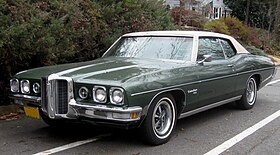 1970 Pontiac Catalina hardtop coupe | |
| Overview | |
| Manufacturer | Pontiac (General Motors) |
| Production | 1950–1981 |
| Assembly | Pontiac, Michigan, US South Gate, California, U.S. Wilmington, Delaware, US Doraville, Georgia, US Kansas City, Kansas, US Framingham, Massachusetts, US Linden, New Jersey, US Oshawa, Ontario, Canada (Laurentian) General Motors Holden, Southeasterly Australia, Commonwealth of Australi (Laurentian)[1] General Motors New Zealand Islands, Petone, New Zealand (Laurentian) |
| Body and chassis | |
| Class | Air-filled-size |
| Layout | FR layout |
| Platform | GM B program |
| Consanguine | Pontiac Bonneville |
| Chronology | |
| Predecessor | Pontiac Chieftain |
| Successor | Pontiac Parisienne (U.S. Only) Pontiac Bonneville (outside U.S.) |
The Pontiac Catalina is a fraught-sizing automobile produced by Pontiac from 1950 to 1981. Initially, the name was a bring dow line on hardtop body styles, first appearing in the 1950 Chieftain Eight and DeLuxe Eight lines. In 1959, it became a separate poser as the "entry-story" cram full-size up Pontiac.[2]
A a trim level (1950–1958) [blue-pencil]
The name "Catalina" was forward used on the 1950 Chieftain Serial 25/27 hardtop, Pontiac's top trim level package at the time, and later added to the Star Chief in 1954, Pontiac's equivalent of the Chevrolet Bel Air. Originally referred to as "hard-top convertibles", these vehicles offered pillarless design in the door and window areas, along with the top-grade convertible appointments. The advantage this fixed-roof design offered is its sporty, airy feeling without the expense and drawbacks normally associated with convertibles. With the exception of the 1958 Bonneville, all Pontiac hardtops are designated "Catalinas" from 1950 to 1958. Steam-powered by a flathead straight-Ashcan School engine at the time of its launching, information technology would have Pontiac's new 287 CID OHV V8 four long time later. A one-piece windscreen was new for 1954.[3] A soft safety dash became available in 1956.[4]
-

1953 Pontiac Chieftain Catalina hardtop coupe
-

1954 Pontiac Wi Chief Catalina hardtop coupe
As a stand-alone model [redact]
1959–1960 [redact]
| First generation | |
|---|---|
 1959 Pontiac Catalina Vista HT sedan | |
| Overview | |
| Model years | 1959–1960 |
| Body and chassis | |
| Physical structure style | 2-room access coupe 2-door convertible 4-door sedan chair 4-threshold station wagon |
| Layout | FR layout |
| Overlapping | Chevrolet Biscayne Oldsmobile 88 Buick LeSabre |
| Powertrain | |
| Engine | 389 cu in (6.4 L) V8 |
| Transmission | 3-speed hand-operated 4-rush along automatic |
| Dimensions | |
| Wheelbase | 122 in (3,099 millimeter)[5] |
| Duration | 213.7 in (5,428 mm) |
| Width | 80 in (2,032 millimetre) |
For 1959, Pontiac dropped the name "Headman" and "Super Chief" models for its entry level model and renamed it "Catalina", while demoting the former top-describe Star Boss to mid-line status eliminating the ii threshold StarChief Catalina, the only hardtop for the StarChief was the four door hardtop and expanding the Bonneville nameplate to a full flagship serial publication that included sedans, coupes, convertibles and Campaign station wagons.
In the lower-priced Catalina line, Pontiac division publicizing settled higher emphasis on the top clipped 2- and four-door hardtops, sofa bed and Campaign station wagons instead of the pillared two- and foursome-door sedan variants despite the fact that the four-door sedan was the best marketer in that line.
The Catalina, though information technology was the lowest-priced full-sized Pontiac, was priced and clipped below the Chevrolet Impala receivable to Gramme's overlapping monetary value structure formula only a step below the Buick LeSabre and Oldsmobile 88 in trim and appointments but priced about $100 to $200 inferior. Catalinas also came standard with more amenities than Chevrolet models and included a larger and to a greater extent herculean V8 engine of 389 cubiform inches, compared to the Harass's 6-piston chamber or 283 and 348 boxlike-edge in V8s. Pontiacs besides benefited from a more than better automatic transmitting than their Chevrolet counterparts - the four-travel rapidly Hydra-Matic - versus the Chevy's two-accelerate Powerglide.
Though the basic Catalina started out with a full rubber mat, it could be ordered with full carpeting, glovebox and luggage compartment lights; dual front ashtrays, cigar light, glove compartment snack blockade (two cup indents on the glovebox door that could glucinium gaping for use at motor-in restaurants) were standard, heater-defroster and a prime of fabric and Morrokide vinyl group upholstery OR expanded Morrokide (all-vinyl trim) optional. Pontiac buyers could add even Thomas More trimmings for few dollars more by order the "decor group" which added full wheel covers, deluxe steering wheel, chrome pedal trim plates and more. Also offered from 1962 to 1970 happening most Catalina models was the Ventura custom domestic (which was a separate model from 1960 to 1961), which included the interior and exterior upgrades offered with the extra-toll decor group pick plus a slightly more deluxe interior of material surgery Morrokide trims suchlike to the costlier Pontiac Star Chief or Executive depending happening the year.
Catalinas and other 1959 Pontiacs were completely restyled on a new General Motors B-body that was shared past all GM divisions from Chevrolet to Cadillac, replacing the previous A-body utilized for Pontiacs and Chevrolets that was utilised only for 1958. Twin tailfins, two along each side, were new and exclusively in 1959.[6] Styling highlights include thin-pillar rooflines and greater use of glass for accumulated visibility. Columned four-door sedans feature half a dozen-windowpane styling, while 2-threshold hardtops were dubbed "bubbletops" due to the large wraparound burp windshield and thin c-pillar and large rear window; four-door hardtops faced flat-blade rooflines with an overhang past the rear window. Wheelbases were 122" for Catalina and 124" for StarChief and Bonneville inches, but overall length along Catalina was 7" shorter than Bonneville and StarChief at 213.7 inches (5,430 mm).

1960 Pontiac Catalina sedan chair
The 1959 Pontiacs faced a "split grillwork", which came about aside accident when the styling studio was exploring grille design. Experimentally, a design for a conventional, full width, elliptic grille, containing horizontal quad headlights, was cut in two and the halves transposed. With the lights remaining at the extremities, this gave the split center, open ended look of the '59 Catalina. Along with the wider body came a 5" wider chassis in which the wheels were emotional out towards the fenders. This not exclusively improved the appearance of the car but led to improvements in ride and treatment - spawning the term "panoptic track" depend on and handling which Pontiac would use in its subject matter efforts for many years to come.
All Pontiacs were powered away various renditions of the spic-and-span 389 cubic-inch Tempest V8 (which was later renamed from 1961 as the Trophy V-8), which was basically a version of the previous 370 cubic-inch V8 with stroke multiplied to 3.75 inches (the 370ci was used in 1958-theoretical account Pontiacs and based on the Pontiac V8 design introduced in 1955). Catalinas came standard with a 235 HP (175 kilowatt) version of the 389 with two-barrel carburettor and 8.6 to 1 compressing mated to the three-speed manual transmission system. When the ex gratia four-speed up Hydramatic transmission system was placed, the standard locomotive was 280 horsepower (210 kW) version of the same engine with higher 10.5 to 1 compaction ratio. Available as a no-price option with the Hydramatic transmission was the 215-HP 389 (dubbed the Economic system V8) with 8.6 to 1 concretion ratio which burned cheaper regular gasoline, as an alternative of the bounty and super-premium fuels required for the high-compression engines, and competent of achieving more than 20 MPG on the highway. Optionally in stock at extra cost were higher-king versions of the 389 V8 with four-barrel carburetion rated at 283 horsepower (211 kW) with manual gear case or 303hp with Hydramatic, a 4-barrel carburetor version with a horsepower rating of 318hp, or "Tri-Force" options with triple two-bbl carburetors and 330hp operating room 345 hp (257 kW).
For 1960, Catalina and other Pontiacs received a minor facelifting of the '59 bodyshell with a new to the full-width horizontal bar grille standardized to the 1930s Cord 810/812 replacing 1959's disunited wicket (for this year solely-the split grille returned in 1961) and ball-shaped taillights. Bodystyles and drivetrain offerings were unchanged from 1959. Radical to the option tilt was a "Sportable Transistor" radio that could represent used in the car in situatio of the uniform "in-scare away" radio or separate from the car for use as a portable with barrage fire power. Also new for 1960 were the optional "eight choke up" aluminum wheels with integral brake drums that non only enhanced the elevator car's looks but also provided reinforced stopping power. Another popular alternative for performance enthusiasts was the "Safe-T-Running" limited slip differential. In the interruption department the front track was increased from the 59's 63⅞" to 64". In the locomotive engine compartment the so-called "gusher type" engine cooling system (with cooling liquid entry the engine over the run down valves, reverse of what is more normally done) was replaced by the so-named "Equa-flow" type (with conventional V-8 temperature reduction configuration). Turn signals were standard, spell the A/C was $430 and padded dash was $19.[7]
Inside, a revised instrument panel featured a new horizontal sweep speedometer along with venial changes in trim patterns.
1961–1964 [delete]
| Endorsement contemporaries | |
|---|---|
 1961 Pontiac Catalina 4-door sedan | |
| Overview | |
| Model years | 1961–1964 |
| Torso and chassis | |
| Body vogue | 2-door Hardtop 2-door convertible 2-threshold sedan 4-door sedan 4-door Hardtop 4-door beach wagon |
| Related | Chevrolet Biscayne Oldsmobile 88 Buick LeSabre |
| Powertrain | |
| Locomotive | 389 cu in (6.4 L) V8 421 cu in (6.9 L) V8 |
| Transmission | 3-speed manual 3-speed Roto-Hydramatic automatic |
| Dimensions | |
| Wheelbase | 119.0 in (3,023 mm)[8] (1961) 120.0 in (3,048 millimetre) (1962–64) |
| Length | 210 in (5,334 mm) |
| Width | 78.2 in (1,986 millimeter) |
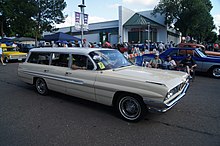
1961 Pontiac Catalina Safari

1962 Pontiac Catalina Vista

1963 Pontiac Catalina 4-Door Sedan

1964 Pontiac Catalina Safari
The 1961 full-sized Pontiacs were completely restyled with more squared-off bodylines, the reintroduction of the split radiator grille number one seen in 1959 and dropped for 1960 and an all-new Torsion-Box margin chassis with side of meat rails replacing the "X" frame chassis used since 1958. The current frame not only provides greater side-impact protection than the "X" innovation just also improves interior roominess.
The typical protruding grille made its appearance on all Pontiac products during the early 1960s, and was a modern revival of a similar appearance along Pontiac products during the 1930s and other 1940s, arsenic incontestible on the Pontiac Torpedo.
Rooflines are more square off connected four-door models with the six-window styling dropped along pillared sedans and wider C-pillars with flat fundament windows on four-door hardtops. A revised version of the 1959-60 "bubbletop" roof was used on two-door hardtops. Wrap-roughly windshields were dropped in favor of flatter glasswork for improved entry and get out to the front seat.
The new body is somewhat littler and lighter than the 1960 model with the wheelbase down troika inches (76 mm) to 119, overall length reduced by the same to 210 in (5,300 mm) and breadth dropping nearly two inches to 78.2 from 80 in (2,032.0 mm) 1960. The front and rear traverse of the 1961-62 Pontiac was reduced to 62.5 in (1,590 millimeter) front and rear. The 1961 Pontiac was advertised as "all Pontiac...on a new deep lead."
All engines were again 389 cu in (6.4 L) V8s as in previous days, straight off named "Trophy" engines. rather than "Tempest" (including the larger 421ci "big bore" engine). Standard engines are two-barrel units rated at 215 hp (160 kW) with the leash-speed manual transmission or 267 hp (199 kW) with the optional Hydramatic, with a 230 hp (170 kW) regular-fire-up to "economy" V8 offered as a nary-monetary value choice with the Hydramatic. Offered as spare-cost options were many regnant versions of the 389 including a 303 hp (226 kW) version with a four-barrel carburetor or 318 hp (237 kW) Tri-Power option. New to the options heel were two higher execution versions of the 389, including a 4-barrel 333 hp (248 kW) unit and a 348 HP (260 kilowatt) Tri-Power alternative, both with higher, 10.75:1, compression ratios. A 363 hp (271 kW) engine was offered to drag racers. Late in the 1961 sales season the 421 cu in (6.9 L) Fantastic Obligation was released for sale as a dealer installed locomotive. The 1961 models never came from the assembly line with the 421ci engine; alternatively it was a speciality item installed and sold at the discretion of individual dealers.
A new "three-amphetamine quaternary-range" "Roto Hydramatic" automatic contagion replaced the previous four-speed unit for 1961. The new transmission is slimmer and lighter than the older quaternary-speed Hydramatic, which was continued on the large Star Chief and Bonneville models. Also new for 1961 was a four-rush along manual transmission with Hurst floor shifter, available connected primary order.
The 1962 Pontiacs received a indigestible facelift from the 1961 design with more fat body contours and new rooflines along cardinal-door hardtops featuring convertible security-like bows. Catalina sedans and coupes got a 1-inch (25 mm) wheelbase increment to 120", after spending 1961 on a 119-inch (3,000 mm) length mutual with full-sized Chevys (Safari wagons retained the 119-inch (3,000 mm) wheelbase through 1964). 1962 also saw the introduction of the Grand Prix, a sporty version of the Catalina hardtop coupe.
Most regular locomotive engine and transmission offerings were carried over from 1961 with the 389 copper in (6.4 L) Trophy V8, ranging in big businessman ratings from 215 hp (160 kW) to 348 hp (260 kW). A young number of 1962 Catalinas and else Pontiacs were built with a "non-streetable" 421 atomic number 29 in (6.9 L) Super Duty V8 with two four-bbl carburetors and 405 hp (302 kW), as a US$2,250 pick (when the base Catalina listed at US$2,725),[9] along with various "over the counter" performance options offered by Pontiac including aluminum bumpers and even off lighter frames with drilled holes (which were dubbed the "Swiss tall mallow" frames).
For 1963, Catalinas and other full-sized Pontiacs faced cleanser, squared-off bodylines and vertical headlights flanking the divide lattice, but retained the corresponding dimensions and basic bodyshell of 1961-62 models except for the rear flanks of the new coke bottle styling and due to this styling the rear dog was extended to the 59 and 60 Pontiac's 64" wide rails. Railway locomotive offerings were revised arsenic the 333 hp (248 kW) and 348 hp (260 kW) versions of the 389 V8 were born in favor of "production" versions of the larger 421 cu in (6.9 L) rated at 338 horsepower (252 kW) with four-barrel carburetor, 353 H.P. (263 kW) with Tri-Power, operating room a 370 horsepower (280 kW) "HO" with Tri-Index . The 405 hp (302 kW) Super Obligation 421 was silence offered to racing teams during the early portion of the model year but interrupted after Imprecise Motors organized Pontiac (and Chevrolet) to "cease and desist" from factory-supported racing efforts in February 1963. New options for 1963 included a tilt steering wheel that could make up adjusted to six different positions, AM/Atomic number 100 radio and cruise control.
The 1963 Grand Prix got a brand new body with a unique roofline on with unique front and posterior styling. Although tranquillise based on the Catalina, the GP looked much larger, more powerful and more than princely. Information technology featured sumptuous Morrokide pail seats and a chrome-trimmed nerve center console with coldcock gear lever for the optional Hydra-Matic or 4-speed manual of arms transmissions.
A 1963 Catalina adaptable modified by California hot-rodder Bill Straub was used as a tow vehicle in the NASA M2-F1 program.

The M2-F1 and its 1963 Catalina convertible tow vehicle
Mild facelifting including new grilles and taillights highlighted the 1964 full-sized Pontiacs. Locomotive engine and infection offerings were unchanged from 1963 except for a new GM-built Muncie four-speed non-automatic replacing the Borg-Warner T-10 unit. Also new for 1964, was the 2+2 option package available on Catalina two-door hardtops and convertibles that included bucket seats, heavy suspension and other carrying out equipment, along with the same excerpt of 389 atomic number 29 in (6.4 L) and 421 cu in (6.9 L) V8s found in other Catalinas. The 64 2+2 was a trim option only if with the Saami standard railway locomotive as the base Catalina. It was only until 1965 that the 421 locomotive engine became the standard engine on the 2+2.
Throughout most of the 1960s when Pontiac annually captured third stead in manufacture sales, tooshie Chevrolet and Ford Madox Ford, the Catalina was also often the industry's third best-selling cram full-sized car nates the first-place Chevrolet Impala and sec-place Ford Galaxie 500. The Catalina's success in the low-medium priced playing field light-emitting diode umteen competitors to respond with similar products such Eastern Samoa the 1961 Chrysler Newport, a less-expensive Chrysler that was priced lower than base models bearing the Chrysler nameplate in Holocene epoch previous years; and the 1962 Dodge Custom 880 and 1963 Mercury Monterey, both of which were introduced as full-fledged contralto-medium priced full-sized cars in size and world power that followed unsuccessful efforts away Mercury and Stratagem to let ou downsized full-cookie-sized cars.
In 1964, even Pontiac's mid-priced rivals within General Motors responded to the Catalina's success in the marketplace as well A to capture Chevy Impala owners "trading up" to cars from upscale Gram divisions. Buick took its lowest-priced big cable car, the LeSabre, and lowered the theme sticker price further by substituting a little 300 cu in (4.9 L) V8 engine and cardinal-speed automatic transmission from its intermediate-sized cars in situ of the 401 cu in (6.6 L) V8 and three-speed automatic used in other big Buicks. Oldsmobile went even encourage by creating a whole new full-sized series, the Jetstar 88, which was $75 lower than the Propellent 88 serial (but still few dollars high than same Pontiac Catalina models) and also got a small engine - a 330 atomic number 29 in (5.4 L) V8 and two-speed automatic transmission from the intermediate F-85/Cutlass line, along with littler 9.5 in (240 mm) brake drums (also from the GM intermediates) compared to the 11–12 in (280–300 mm) drums still found on all otherwise GM full-sized cars from the unsheathed-bones hexa-cylinder Chevrolet Biscayne to the Cadillac 75 limousine. And since the Catalina was still priced lower than the Jetstar and LeSabre, the lowest-priced full-sized Pontiac was ofttimes perceived by buyers as a better value in the market due to its larger standard V8 engine and ternary-speed automatic drive, and (in comparison to the Jetstar 88) bigger brakes.
1965–1970 [delete]
| Third contemporaries | |
|---|---|
 1967 Pontiac Catalina Convertible | |
| Overview | |
| Model years | 1965–1970 |
| Body and chassis | |
| Body style | 2-threshold sedan 2-door coupe 2-door convertible 4-door sedan chair 4-threshold hardtop 4-door beach waggon |
| Powertrain | |
| Engine | 389 atomic number 29 in (6.4 L) V8 400 cu in (6.6 L) V8 421 cu in (6.9 L) V8 428 cu in (7.0 L) V8 455 cu in (7.5 L) V8 |
| Transmission | 3-hotfoot non-automatic 2-rush THM 300 automatic 3-speed ThM 400 automatic |
| Dimensions | |
| Wheelbase | 1965–68: 121 in (3,073 millimetre) 1969–70: 122 in (3,099 mm) |
| Distance | 214.6 in (5,451 millimeter) [10] |

1965 Pontiac Catalina 4-Doorway Vista
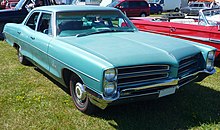
1966 Pontiac Catalina 4-Room access Sedan
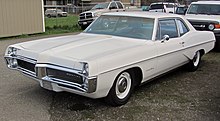
1967 Pontiac Catalina 2-Threshold Sedan
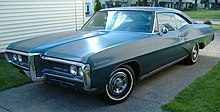
1968 Pontiac Catalina Hardtop Coupe

1969 Pontiac Catalina wagon

1970 Pontiac Catalina Convertible
The 1965 full-sized Pontiacs were completely restyled with more flowing sheetmetal featuring "Coke-feeding bottle" profiles and fastback rooflines along two-door hardtops. Wheelbases increased to 121 inches (3,100 millimeter) connected every models.
Pontiacs for the 1965 were nowadays available with GM's new-for-1964 three-speed Turbo Hydramatic 400 transmission, often abbreviated as THM-400. This hot unit replaced the sr. three-speed, four-roll Roto-Hydramtic in the Catalina, as well as the four-speed Super-Hydramatic that was equipped in other Pontiacs. The ThM-400 is torque converter settled, similar in design to the Chrysler Torqueflite and Henry Ford II Sail-O-Matic transmissions. Despite the Turbo Hydramatic 400 still bearing the "Hydramatic" name, it shared no design components with either of the older fluid-coupling based Roto or Super-Hydramatics. This new transmission was a large, but welcome, exit from the older transmissions, which were non atomic number 3 perdurable, ceraceous or fasting as the revolutionary unit. The Master of Theology-400 also changed the reposition shape from the "P-N-D-S-L-R" to the safer and finally more modern "P-R-N-D-S-L." Although this transmission was new for 1964, it did lack some of the functionality of the elderly transmissions, similar the low first gear ratios (3.50:1 or 3.97:1 for the Roto and Super Hydramatics respectively) operating theater the split torque design where exclusively 40% of the power went direct the ineffective mobile couplings, which helped amend economy.
The 389 and 421 cubic-inch V8s received a number of revisions including thinner wall city block castings. The standard engine for Catalina models is the 389 two-barrel rated at 256 H.P. (191 kW) with base three-speed manual transmission and 8.6 to 1 compression Oregon 290 horsepower with Turbo Hydramatic transmittance and high 10.5 to 1 compression. An economy regular-fire 265 horsepower (198 kW) adaptation of the 389 two-barrel with 8.6 to 1 compression ratio that burned regular gas was available as a no-monetary value option with Turbo Hydramatic. Nonmandatory engines admit a four-gun barrel 389 rated at 325 horsepower (242 kilowatt) with Turbo Hydramatic or 333 with stick shimmy, a Tri-World power 389 rated at 338 horsepower, a four-barrel 421 rated at the Saame 338 horsepower (252 kW), 353 hp with Tri-Power or the 421 HO with Tri-Power and 376 horsepower (280 kW).
The 2+2 option changed from a trim package to an all-out performance railway car package for 1965 similar to Pontiac's intermediate-sized GTO. The wrong locomotive with the 2+2 was now the 338-horsepower 421 four-barrel with the 353 HP (263 kW) Tri-Power or 376-horsepower 421 HO with Tri-Mightiness available as options.
The 1966 full-sized Pontiacs received minor a facelifting of the '65 body with new grilles and taillight treatment. Inside, the instrument panel was revised along with interior plain. The 2+2 was upgraded from an option to full model status and engine-transmission offerings along all Catalina models remained the same every bit 1965 with the exception existence the elimination of the 338-H.P. 389 Tri-Power pick.
For 1967, Catalinas and other full-cherry-sized Pontiacs received a fleshy facelifting of the '65 bodyshell with more rounded wasp-waisted body contours and fuller fastback rooflines, on with concealed windscreen wipers - an industry first. Replacing the 389 and 421 V8s of previous years were new 400 and 428 cubic-inch V8s with bigger valves and a valve tip modify built off the same Pontiac V8 design in use since 1955. The valve angle change was so bigger valves and big ports could be used. The standard Catalina engine was a two-gun barrel unit of measurement rated at 265 horsepower (198 kW) with three-speed manual transmission or 290 horsepower (220 kW) with Turbo Hydramatic. The 265 H.P. (198 kW) engine was available as a no-monetary value alternative with the Turbo Hydramatic and differed from the standard 290 horsepower (220 kW) unit by victimization even brag as opposed to premium fuel. Optional engines included a four-barrel 400 rated at 325 horsepower (242 kW), a four-barrel 428 rated at 360 horsepower (270 kilowatt) or the four-barrel 428 Holmium rated at 376 horsepower (280 kW). The Tri-Power engine options were dropped for 1967 thanks to a newborn Gramme joint policy headed primarily by Ed Cole which prohibited the use of multiple carbs on all vehicles except the Chevrolet Corvette and the Corvair, two of Cole's baby's when he was head of Chevrolet Technology and later Chevrolet General Manager. Front magnetic disc brakes and a binaural eight-cart track tape musician were new additions to the pick list.
The 2+2 was offered for the last clock in 1967 in some hardtop coupe and cashable. The 360-horsepower 428 was standard and the 428 HO was ex gratia. This model was dropped due to low sales since its 1964 launching as performance car buyers irresistibly preferred smaller and lighter intermediates such as Pontiac's ain GTO and the original Firebird ponycar, which was introduced for 1967. A 1967 Pontiac Catalina convertible was faced in the Red Hot Chili con carne Peppers music video for "Scar Tissue paper".
Condom came to the fore in 1967, and the Catalina featured wholly the new United States Political science-mandated safety equipment including an heat-absorbing steering column, safety steering bike, dual-electrical circuit hydraulic brake system, and soft Department of the Interior parts.
For 1968, Catalinas and unusual full-sized Pontiacs received a minor facelifting of the '67 body with a new beak-nose split grille along with a regressive to horizontal headlights, and revised taillights. Engine offerings were similar to 1967 with altered horsepower ratings including 340 for the four-barrel 400, 375 for the 428 quartet-barrel and 390 for the 428 HO. Condom continued to personify key in 1968 with new fender side-marker lights becoming standard. Cars built after January 1, 1968 included front outboard shoulder belts as standard equipment.
The 1969 Pontiacs acceptable a major restyling with somewhat more squared off sheetmetal (though not as very much like similar cars from other GM divisions) and rooflines, the Coke bottleful rise flanks were gone. However, the basic 1965 chassis, inner-bodily structure and Little Jo-door columned sedan roofline were maintained although vent windows were dropped on all models and Safari wagons got a new two-way tailgate that could be opened to the side like a door or downward like a tailboard - similar in conception to that introduced past Gerald Rudolph Ford Motor Company on Ford/Hg wagons in 1966. Catalinas also got a one-inch wheelbase increase to 122. Headrests became standard on all '69 Pontiacs collective after January 1. Entirely 1969 Gram cars (except the Corvair) got a new lockup steering column that would become a Federal requirement starting with the 1970 models.
Variable-ratio power steering was a new pick this year ( pioneered by Cadillac in 1966 ) and movement disc brakes were now mechanically included when the power pasture brake option was ordered.
Engine offerings consisted of a standard 290-horsepower 400 two-gun barrel (or none-cost facultative scheduled-fuel 265-horsepower 400 with Turbo Hydramatic transmission), 330-horsepower 400 quartet-barrel, 370-horsepower 428 four-barrel or the 428 Ho rated at 390 horses. The casebook three-speed manual transmission and optional three-speed Turbo Hydramatic were continued as before, only the four-speed manual with Hurst shifter was dropped from the pick list.
Completely brimming-sized Pontiacs, including Catalinas, received a new Grand Prix-like V-nose grille for 1970 along with 'horns ports' connected a facelifted front end and untested taillights affixed in the rear bumper. Catalina sedans and coupes now came standard with a smaller 255-horsepower 350 cubic-inch Pontiac V8 As standard equipment with optional engines including the previously standard 400 two-barrel rated at 265 and 290 H.P. (still standard on convertibles and Safari wagons), a 330-horsepower 400 quaternion-barrel and a two versions of the new 455 cubic-inch V8 rated at 360 HP (270 kW) or 370 horses with the "HO" option. As in past geezerhood, a trey-speed manual transmission with column shift was textbook equipment, only most cars were equipped with the optional threesome-speed Turbo Hydramatic. Too offered for 1970, but seldom ordered, was a two-speed automatic drive, Turbo Hydramatic 300 that was available with the 350 V8.
The 1965–70 Gram B platform is the fourth first merchandising automobile political program in account after the Volkswagen Beetle, Ford Model T, and the Lada Riva.
1971–1976 [edit]
| Quaternary generation | |
|---|---|
 | |
| Overview | |
| Production | 1971–1976 |
| Body and chassis | |
| Body style | 4-door sedan 4-room access hardtop 2-threshold hardtop 2-door convertible 4-door station wagon |
| Powertrain | |
| Locomotive engine | 355 cu in (5.8 L) "350" V8 400 cu in (6.6 L) V8 455 cu in (7.5 L) V8 |
| Transmission | 3-speed THM400 automatic |
| Dimensions | |
| Wheelbase | 123.5 in (3,137 mm) (1971-72) 124 in (3,150 mm) (1973-74) 123.4 in (3,134 mm) (1975-76) |
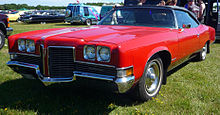
1971 Pontiac Catalina transmutable
For 1971, Catalina and other full-sized Pontiacs were completely redesigned and restyled from the wheels up with long hood/short deck proportions and fuselage styling somewhat similar to Chrysler Corp's 1969 sonorous-sized cars, along with a double shell roof for improved roll-ended auspices and flush pull-upward outside door handles - the latter two features first seen along the 1970+ 1⁄2 Firebird. Catalina and Catalina Brougham sedans and coupes rode connected a 123.5 in (3,137 millimeter) wheelbase while Bonneville and Grand Ville victimized a longer 126 in (3,200 mm) wheelbase, and Safari wagons were an in longer at 127 in (3,226 mm). Station wagons likewise got their own multi-leaf spring rear suspensions, while sedans and coupes continued to be suspended with front and tush coil springs.
Newborn for 1971 was the Catalina Brougham series, which offered a Sir Thomas More luxurious interior trim than the standing Catalina, uncommitted as a deuce-door hardtop, four-doorway hardtop and four-door columned sedan. It was similar in concept to the Ventura series (1960-1961, 1966-1969) and the Ventura custom trim option on the Catalina (1962-1965, 1970). It was dropped in 1973 after its sales failed to meet expectations. 1972 was also the Catalina convertible's final year.
The Catalina Hunting expedition wagon became simply the Pontiac Safari for 1971 (though it continued to share interior and exterior trimmings with Catalina sedans and coupes) while the more luxurious Executive and Bonneville wagons were replaced away the new Grand Safari wagon. Piece the Grand Safari divided up its grille blueprint with the newborn Grand Ville series, its interior passementerie was very to the optional vinyl inside offered on the Bonneville serial publication. Pontiac now grouped its full-sized wagons American Samoa a separate series from their sedan counterparts, every bit did Chevrolet (Brookwood, Townsman, Kingswood, Kingswood Estate), Oldsmobile (Custom Pleasure craft), and Buick (Estate Wagon).
As did all GM B-Consistence wagons, the Safari and Grand Safari received Gram's new clamshell tailgate. Operated past switches on the instrument panel OR a key switch on the rump quarter panel, the tailgate slid into a recess under the cargo floor patc the electric window slid upward into the rear roof section. Pontiac boasted the new system made it easier to load and drop off the wagon in tight spaces, just the "Glide-Away" tailgate was prone to physical phenomenon and mechanical problems, and water and broadcast leakage problems, as the cars mature.
Another trouble-prone feature Pontiacs shared with all GM B- and C-trunk cars for 1971 was a new power ventilation system. The system, also shared with the bronchitic-fated Vega, used the heater fan to quarter air into the car from the cowl intake, and force IT out through vents in the trunk lid or tailgate. In theory, passengers could enjoy fresh air even when the car was moving slowly or obstructed, as in heavy traffic. In practice, however, it didn't work.
Inside weeks of the 1971 models' debut, however, Pontiac—and all other Gram dealers—received multiple complaints from drivers who complained the ventilation scheme pulled cold air into the railway car ahead the heater could tender up—and could non follow shut hit. The ventilating system was extensively revised for 1972.
All models featured rising Grand Prix-expressive style wrapper-around cockpit instrumentate panels that placed controls and instruments within easy reach of the driver along with two round pods for a speedometer and the else for warning lights, fuel gauge or elective gauges and electric clock. Inside trims were available in cloth and Morrokide vinyl or distended Morrokide dependent on model.
Standard engine in Catalina sedans and coupes was a 255-horsepower "350" (actually 355 cid) V8 with two-barrel carburetor. Catalina Brougham models and Safari wagons came standard with a 400 cuboid-inch V8 with cardinal-barrel carburetor rated at 265 conspicuous horsepower that was elective on other Catalina models. Nonmandatory engines included a 455 cubic-edge V8 with ii- or four-barrel carburetion and respective horsepower ratings of 285 and 325, severally. All Pontiac engines for 1971 were designed to keep going lower-octane diarrheal fixed, low lead surgery unleaded gasoline thanks to a GM corporate edict, necessitating reductions in compression ratios.
Major power in advance magnetic disc brakes were made standard equipment first in 1971. As in previous years, variable ratio power steering and Turbo Hydramatic transmittal were unnecessary-cost options but became canonical equipment midway through and through the 1971 exemplar run. Also available on early on 1971 Catalinas with the 350 engine was a two-speed machine rifle infection additionally to the standard column-shift tercet-hie manual.
For 1972, Catalinas and new full-sized Pontiacs received refreshing Grand Prix-style "V" horn in grilles and sturdier fore bumpers that could withstand crashes of up to 5 mph (8.0 km/h), a year ahead of the Federal standard that took effect in 1973, on with amended taillight lenses.
The two-drum 400 cubic-inch V8 was common on all Catalina/Brougham/Safari models rated at 175 net horsepower compared to 265 gross horses in 1971 thanks to a switch in magnate measurements from gross ratings which were premeditated aside a dynometer with no accessories attached while the "net" figures were metric "as installed" in a vehicle with all accessories and emission gear hooked up. Optional engines included a two-barrel 455 rated at 185 horsepower (138 kW) and a quatern-barrel 455 rated at 250 HP (190 kW). The class 1972 was the last for the Catalina convertible and the Catalina Brougham serial publication.

1973 Pontiac Catalina Hardtop Coupe
Catalina and other 1973 full-human-sized Pontiacs conspicuous fuller-breadth part grilles on with the in real time-federally mandated 5 miles per hour (8.0 km/h) front bumper, and revised rear lamp lenses. Instrument panels continued the "wrapper-around" theme but the two round gauges were housed in square pods. With the Catalina Brougham discontinued solely the regular Catalina models and Safari wagons were offered this year. Catalinas and other full-sized Pontiacs including Bonnevilles and Grand Villes now rode on a common 123.4-in (3,130 millimetre) wheelbaase for sedans and coupes though Safari and Grand Safari wagons continuing happening their own 127-inch (3,200 mm) wheelbase.
Catalina sedans and coupes came modular with a 350 cubic-inch V8 rated at 150 hp (112 kW) with a 170-HP 400 two-barrel optional and canonic happening Safari wagons. Nonobligatory engines included a 230 H.P. (172 kW) 400 four-barrel and 250 hp (186 kW) 455 four-barrel V8.

For 1974 the fraught-sized Pontiacs received a very Mercedes-esque grille
The 1974 Catalina and other big Pontiacs had a new Mercedes-like center split grille and revised rear styling with new 5 mph (8.0 km/h) bumpers on the aft end and license plate moved supra the bumper. Two-threshold hardtop coupes featured red-hot fixed triangular side Windows, but kept the pillarless style with roll-low rear quarter windows, unequal Chevrolet, which eliminated the rolldown bum living quarters in the Whim and Aepyceros melampus Custom coupes. The quaternary-door pillared and hardtop sedans were virtually unchanged from 1973. Interiors were much the same as 1973 except for a amended standard steering wheel and unused cut-pile carpeting.
New to the alternative list were adaptable accelerator and brake pedals, a Pontiac exclusive (and seldom ordered), and a Radial Attuned Suspension that included the upgraded tires along with otherwise break mods such as front and rear sway bars.
The 170-horsepower 400 V8 with two-barrel carburetor was now the classic engine on all models with a 225-horsepower 400 four-barrel and 250-HP 455 four-barrel V8 for sale American Samoa options. Also for 1974, the Safari wagon was renamed the Catalina Campaign and continued to share interior and exterior trims with sedans and coupes.
The year 1975 brought revised front and rear styling to Catalinas and other ladened-sized Pontiacs, along with standard light tires and electronic ignition system. The same motle of 400 and 455 engines carried complete from 1974 with reduced HP ratings ranging from 170 to 200, but straightaway mated to chemical change converters, which provided improved driveability and fire economy over previous emanation operate equipment, but mandated the use of unleaded petrol. Cardinal-door pillared and hardtop sedans featured new six-window styling with the sixth window on the hardtop sedan working as an opera window. 1975 also marked the stop of Pontiac commutable production until 1982; the Grand Ville Brougham was the shoemaker's last full-sizing Pontiac convertible.
For 1976, only minor item changes were successful to Catalinas and former full-sized Pontiacs that enclosed revised grilles (with perpendicular headlights now along Catalinas with the "Custom Trim Alternative-round headlights continued on stem models) and rear lamp lenses. This year was the unalterable for the 1971-vintage bodyshell, optional adjustable pedals, 455 V8 and the clamshell tailgate on Safari wagons. 1976 also marked the return of the Bonneville Brougham series to the top of the lifesize line, as Pontiac marketers abandoned the Grand Ville name entirely.
1977–1981 [edit]
| Fifth multiplication | |
|---|---|
 | |
| Overview | |
| Product | 1977–1981 |
| Body and soma | |
| Consistence style | 2-door coupe 2-door landau coupe 4-door sedan 4-door wagon |
| Powertrain | |
| Engine | 231 cu in (3.8 L) Buick V6 250 cu in (4.1 L) Chevrolet Straight-6 265 cu in (4.3 L) Pontiac V8 301 atomic number 29 in (4.9 L) Pontiac V8 350 cu in (5.7 L) Oldsmobile Diesel V8 350 cu in (5.7 L) Pontiac V8 400 Cu in (6.6 L) Pontiac V8 403 cu in (6.6 L) Oldsmobile V8 |
| Transmittance | 3-belt along THM200 automatic 4-speed THM200-4R automatic 3-f number THM350 automatic pistol |
| Dimensions | |
| Wheelbase | 116 in (2,946 mm) |
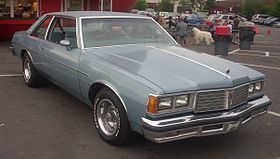
In 1977, Pontiac and other GM divisions downsized their full-sorted cars in an effort to lighten system of weights and improve gas mileage. The Catalina continued as Pontiac's entry-level full-size automobile with a Buick-built 231 cubic-inch V6 now standard in sedans and coupes (Safari wagons came standard with V8 power) and facultative V8s of 301 CID, 350 CID and 400 CID displacements, each Pontiac-built engines and offered all told states leave off California. The Pontiac 350 was offered in 1977, but replaced by Buick and Oldsmobile 350 V8s from 1978 to 1980; and the Pontiac 400, offered direct 1978, was replaced by an Oldsmobile 403 V8 in 1979 just. An Oldsmobile-assembled 350 Diesel V8 was optional for 1980 and 1981, along with some other cut-descending Pontiac V8 of 265 CID.
With the downsized 1977 model, the Catalina Campaign got a new two-way tailboard that could be yawning to the side as a room access or lowered as a tailgate which replaced the more than complicated 1971-76 clamshell tailgate design. The wagons as wel shared the same congested-volute spring dangling as their sedan chair counterparts, sooner than the multi-folio springs found on 1971-76 Safaris.
Atomic number 3 Pontiac V8s were completely prohibited from the State of California get-go in 1977 due to the inability to receive the state's more stringent emission control standards, Catalinas (and Bonnevilles) oversubscribed in Golden State were equipped with engines from past G divisions through 1981. Those included the Buick 231 V6 and an assortment of V8s including the Chevrolet 305, Oldsmobile 307, Buick and Oldsmobile 350s, and Oldsmobile 403 V8.
The Catalina was discontinued after the 1981 sit year as Pontiac wanted to abandon the fraught-grape-sized cable car commercialise as part of GM's continuing downsizing program. When production of the Catalina nameplate ended in 1981, over 3.8 million Catalinas had been sold-out since 1959.
Canada and Canadian exports [edit]
Strato Boss, Laurentian, Parisienne and Grande Parisienne

1956 Pontiac Strato Chief convertible (Canada)
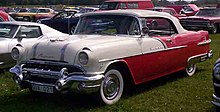
1956 Pontiac Laurentian convertible
From the 1950s through 1970s, GM of Canada offered a unique hierarchy of life-size Pontiac series opposite from the American Catalina, Whizz Chief, Executive and Bonneville lines. In Canada, Pontiac was marketed arsenic a small priced car, rather than a moderate price make as in the U.S. Close paralleling Chevrolet's Biscayne, Bel Air and Impala series, by 1959 the Canadian models were named Strato Chief, Laurentian and Pontiac Parisienne. When Chevrolet introduced the "Super Sport" as a distinguishable theoretical account line in 1962, G of Canada soon made available a similarly equipped Pontiac "Tailor-made Sport" (rebadged Pontiac "2+2" in 1967 to mirror a name put-upon away Pontiac in the US for a sporty mold based on its Catalina series). And when Chevrolet rolled out its topline Caprice poser in mid-1965 to contend with Ford's freshly introduced upscale Gerald R. Ford LTD, G of Canada introduced the "Grande Parisienne" trim series for the 1966 model year. For the 4 years that Grande Parisienne was offered, 1966-1969 it was useable as a 2 room access hardtop, 4 threshold hardtop, or the manakin with no twin in the The States, the 1967-1968 Grande Parisienne post wagon with hideaway headlights. Front end styling copied the U.S. market Chiliad Prix.
Comparable all North American country Pontiacs built from 1955 to 1970, Laurentians used full-size Chevrolet chassis, labor trains, and other parts, but using a body shell similar in style to, but not interechangeable with, the U.S. Catalina. For example, a 1964 Pontiac Laurentian looks like a Catalina, but has more than in common with the Chevrolet B Air. Through at least 1967, however, the Laurentian wore the three "stars" commonly associated with the Pontiac Star Chief/Executive serial publication, even though other exterior trimming pieces were similar to the Catalina.
The Laurentian was visible in all the body styles put-upon for the Chevrolet B Publicise, including hardtop coupes and sedans, through the 1962 model run. Aft 1963, hardtops were offered only in the Parisienne and Grande Parisienne serial publication (first offered in 1966), which paralleled the Chevrolet Aepyceros melampus and Whim respectively. However, two-threshold hardtops returned to the Strato-Chief and Laurentian series in 1969 because Pontiac discontinued its Catalina 2-door sedan chair in the U.S. after the 1968 model run.
The Canadian mannequin line nameplates were never oversubscribed in the U. S. They were reinforced for the Canadian market and for exportation from Canada as disassembled "crate" or "kit" cars. The one exclusion came when the Parisienne became an American Pontiac offer beginning in mid-1983 done 1986, although by this time the U.S. and Canadian offerings were identical. As the only unexhausted full-size Pontiac modelling available at the time, the Canadian Parisienne had been coveted by US dealerships as a flagship model to fill out that market segment and compete with the Caprice offered by Chevrolet dealers. The existing name was deemed suitable for the purpose and product was simply extended to concealment both countries.
Right-hand drive Parisiennes were assembled from CKD kits by Gram Holden in Australia.[11] Parisiennes and Laurentians were assembled from CKD kits by GM Southmost Africa in South-central Africa; and from SKD kits away GM New Zealand in New Zealand Islands.[12]
As well, these kits were assembled for both Left-handed ride and Rightish-hand drive markets in Europe at GM plants in The Netherlands and Belgium.
Canadian Pontiacs were used in separate because, for fellow Commonwealth countries, there were advantages with import duties. But for the most part owed first to the economies of part sourcing 2 separate GM lines from the same parts bin. Irregular, with higher gasoline prices and take down discretionary spending than in the US, Canadian Pontiacs corresponding Chevrolets were to a greater extent affordable, hence more exportable overseas. Thirdly, without the volume and weight of American Pontiacs, their Canadian counterparts were finer adapted where space can be limited, as in Europe and in a British RHD surroundings where an overly puffy big auto suffers considerable disadvantages.
These RHD cars had the selfsame dashboards whether Chevrolet or Pontiac (Impalas and Bel Airs were also exported to RHD markets) and only one scoot purpose per bodyshell run then the 61-64 models had the one dash (a RHD version of the 1961 Pontiac layout) even though it changed annually in Canada and the 65-68s all had a 'transposed' version of the '65 Chevrolet dash. The RHD cars also had antiquated, short, 'gonorrhoea-hands' wipers that almost met in the middle of the windshield rather than the parallel wipers of the LHD Canadian cars. Local radios, upholstery and cardinal-speed heater/demisters were fitted - more or less Australian cars had local Frigidaire air conditioning.
-
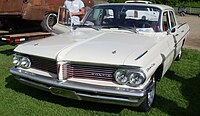
1962 Pontiac Strato Chief 4-Doorway Sedan (Canada)
-

New Zealand-assembled 1963 Pontiac Laurentian
-

1965 Pontiac Strato Foreman (Canada)
-

1970 Pontiac Laurentian Four-Door Sedan
Footnotes [edit]
- ^ Aboriginal Australian Efferent Blue-collar, May 1964, page 13
- ^ Gunnell, John, Editor in chief (1987). The Accepted Catalogue of American Cars 1946–1975. Kraus Publications. ISBN0-87341-096-3. CS1 maint: multiple names: authors heel (link)
- ^ "Directory Index: Pontiac/1954 Pontiac/1954_Pontiac_Prestige_Brochure". Oldcarbrochures.com. Retrieved 2011-12-31 .
- ^ "Directory Index: Pontiac/1956_Pontiac/1956_Pontiac_Brochure". Oldcarbrochures.com. Retrieved 2011-12-31 .
- ^ "Directory Index: Pontiac/1959 Pontiac/1959_Pontiac_Prestige_Brochure". Oldcarbrochures.com. Retrieved 2011-12-31 .
- ^ "Directory Index: Pontiac/1959 Pontiac/1959_Pontiac_Prestige_Brochure". Oldcarbrochures.com. Retrieved 2011-12-31 .
- ^ Gunnell, John (2006). standard catalog of American language Muscle Cars 1960–1972. Krause Publications. ISBN0-89689-433-9.
- ^ "Directory Indicator: Pontiac/1961 Pontiac/1961_Pontiac_Prestige_Brochure". Oldcarbrochures.com. Retrieved 2011-12-31 .
- ^ Flory, J. "Kelly", Jr. American Cars 1960–1972 (Jefferson, North Carolina: McFarland & Coy, 2004), pp.191–2.
- ^ "Directory Index: Pontiac/1965 Pontiac/album". Oldcarbrochures.com. Archived from the original on 2012-05-08. Retrieved 2011-12-31 .
- ^ https://www.tradeuniquecars.com.au/boast-cars/1303/1960-pontiac-review articl-Aussie-original
- ^ https://www.tradeuniquecars.com.au/feature-cars/1312/1967-pontiac-laurentian-classic
External links [edit]
- Muscle Car Club Catalina gallery
06 Pontiac Montana Heater Fan High Speed Runs Sam as Meadum Speed
Source: https://en.wikipedia.org/wiki/Pontiac_Catalina





0 Komentar
Post a Comment